Securing the Defense AI Supply Chain: A Practical CMMC 2.0 and NIST Framework for Vendor Management
Artificial Intelligence (AI) adoption is moving at a blistering pace across the Defense Industrial Base (DIB). From automated code assistants to predictive maintenance algorithms, AI tools offer unprecedented operational advantages. However, these tools introduce a blind spot that standard cybersecurity reviews (like a basic SOC 2 or ISO 27001) are entirely unequipped to catch.
For defense contractors, onboarding an unvetted AI vendor is not just a technical risk—it is a fast track to a failed Cybersecurity Maturity Model Certification (CMMC) audit, lost contracts, and severe legal liabilities. If an AI tool mishandles your data, Controlled Unclassified Information (CUI) can leak directly into commercial training models or public domains.
To maintain a defensible, mission-ready supply chain, compliance and security professionals must know how to enforce CMMC 2.0 and NIST controls directly onto their AI vendors.
This article sets out the regulatory architecture governing AI vendors in the defense supply chain, identifies the failure modes that recur in assessment, and provides a five-stage intake and monitoring lifecycle that produces the evidence a DIBCAC or C3PAO assessor will request.
- The Legal and Regulatory Pillars: Mapping AI to Defense Frameworks
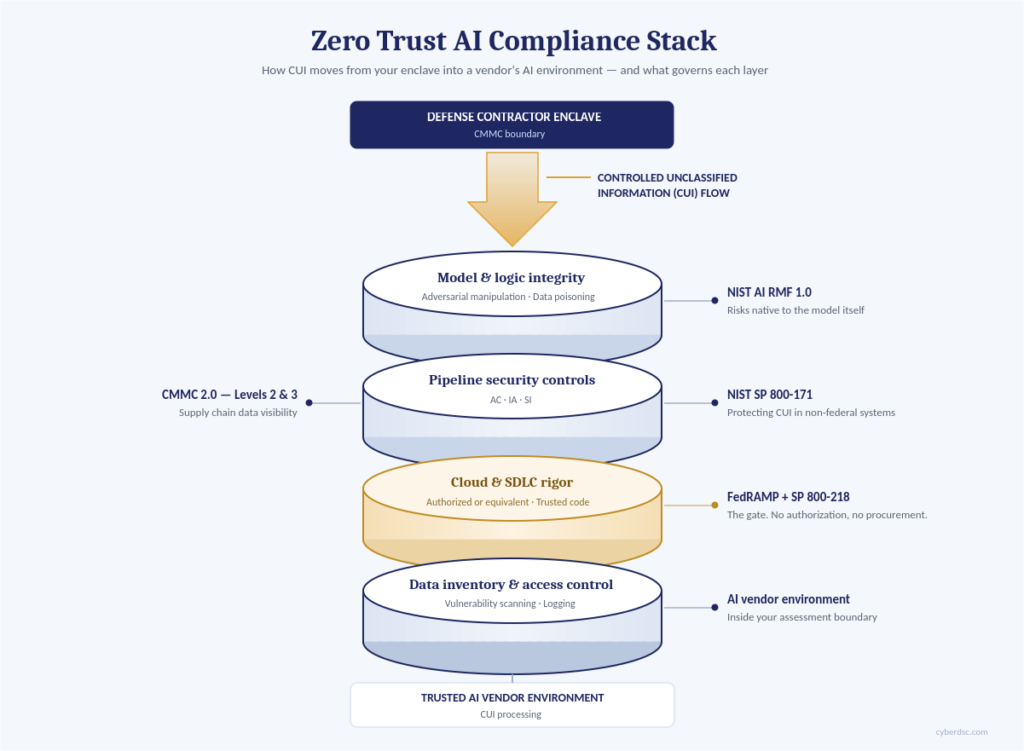
Four instruments govern this area. They operate at different levels and address different risks. Treating them interchangeably is the most common structural error in AI vendor programs. Protecting your organization requires aligning your vendor management process with four critical defense frameworks:
CMMC 2.0 (Levels 2 & 3): This clause is the operative contractual obligation. Three provisions bear directly on A vendor management: Adequate security. The contractor must implement NIST SP 800-171 on covered, contractor information systems that process, store, or transmit covered defenseinformation. Cloud service providers. Where the contractor uses an external cloud service provider to store, process, or transmit covered defense information, the contractor must require and ensure that the provider meets security requirements equivalent to those established for the FedRAMP Moderate baseline. A commercial AI platform delivered as SaaS falls within this provision when CUI enters it.
Cloud service providers. Where the contractor uses an external cloud service provider to store, process, or transmit covered defense information, the contractor must require and ensure that the provider meets security requirements equivalent to those established for the FedRAMP Moderate baseline. A commercial AI platform delivered as SaaS falls within this provision when CUI enters it.
Flow-down. The clause must be included in subcontracts for operationally critical support or where subcontract performance will involve covered defense information. Practitioners should note that the clause does not distinguish between a subcontractor performing technical work and a software vendor whose product ingests the same data.
Incident reporting. The contractor must rapidly report cyber incidents to the Department of Defense within 72 hours of discovery. A contractor that cannot obtain timely incident notification from its AI vendor cannot satisfy this obligation.
2. NIST SP 800-171:
800-171 supplies the control set. AI-mediated data flows are subject to the same requirements as any other flow. Several families warrant particular attention in this context:
Access Control (3.1) — including restriction of access to the vendor’s model artefacts,
training corpora, and inference logs, not only to the customer-facing interface.
Identification and Authentication (3.5) — where AI platforms are integrated via API
keys or service accounts, which frequently bypass the organisation’s identity controls.
System and Information Integrity (3.14) — monitoring for unauthorised use and anomalous behaviour within the AI system boundary.
System and Communications Protection (3.13) — specifically 3.13.11, requiring FIPS- validated cryptography for the protection of CUI confidentiality.
Practitioners must confirm which revision applies to the contract at hand. Revision 3 restructured the families and revised the requirement numbering; a control reference that is correct under Revision 2 may not map cleanly. Assessment scope follows the contract, not the most recent publication.
3. NIST AI Risk Management Framework (AI RMF 1.0): 800-171 was not written to address adversarial machine learning. It presumes a system that behaves deterministically when correctly configured. The AI Risk Management Framework, organised around the Govern, Map, Measure, and Manage functions, addresses the residual category: training data provenance, model integrity, adversarial robustness, and outputreliability. The AI RMF is voluntary. It is nonetheless the reference framework a defensible program will cite, and increasingly the framework against which sophisticated primes assess their subcontractors’ AI governance.
4. FedRAMP & NIST SP 800-218 (SSDF): Under DFARS 252.204-7012, cloud-based AI tools (SaaS/PaaS) handling CUI must be FedRAMP Authorized at the Moderate or High baseline, or prove exact technical equivalency. Furthermore, the Secure Software Development Framework (SSDF) ensures the underlying models were built without supply chain tampering.
3. The Severe Vulnerabilities Facing the DIB
Three failure modes account for the majority of AI-related exposure in the defense supply chain.
Inadvertent disclosure through the inference interface. An employee submits a technicaldata package, a statement of work, or an engineering description to a commercial model to obtain a summary or a rewrite. The submission is transmitted to, and frequently retained by, a third-party system that has not been assessed. Under DFARS 252.204-7012 this is a safeguarding failure and, depending on the circumstances, a reportable cyber incident. Where the data is export-controlled, separate obligations under the ITAR or EAR may be implicated. This failure mode is unintentional, routine, and rarely detected without egress monitoring.
Adversarial prompt injection. Where the vendor’s AI system is exposed to untrusted input — documents, retrieved content, or user-supplied text — an adversary may craft input that causes the system to disregard its operating constraints, disclose system configuration, or take unintended action on connected systems. This risk scales with the degree of integration between the AI system and the contractor’s internal environment.
Training data and model supply chain compromise. Modification of a vendor’s training data or model artefacts may degrade output integrity in ways that are not apparent at the point of use. In predictive maintenance, logistics, or targeting-adjacent applications, the consequence is a silent reduction in reliability. This risk is low-probability and high- onsequence, and it is the risk that the SSDF and the AI RMF exist to address.
4. The 5-Stage Defense AI Vendor Lifecycle
To neutralize these threats before they hit your environment, you must implement a repeatable, auditable procurement path that can withstand intense Defense Contract Management Agency (DCMA) or DIBCAC reviews.
Stage 1: Scoping and Data Identification
Before evaluating software features, determine the highest classification of data entering the vendor’s AI ecosystem. If it is Federal Contract Information (FCI) only, basic CMMC Level 1 hygiene applies. If it is CUI, full NIST SP 800-171 alignment is triggered. If the data is bound by ITAR, the vendor must guarantee 100% U.S. sovereign hosting, meaning zero foreign nationals can have access to the data or data annotation loops.
Stage 2: The FedRAMP and CMMC Gatekeeper
If the AI tool is hosted off-premise, verify its status on the FedRAMP Marketplace. If authorization or proven equivalency is absent, procurement stops immediately. Demand a clear Data Flow Diagram to verify how your data is isolated from other commercial tenants, and ensure all data at rest and in transit utilizes FIPS 140-validated cryptographic modules (NIST SP 800-171 Control 3.13.11).
Stage 3: Targeted NIST AI Assessment
Audit the vendor with three non-negotiable technical questions:
- How do you restrict access to the underlying model weights and training logs? Is Role-Based Access Control (RBAC) enforced? (NIST SP 800-171 3.1.1)
- Can you document your model’s training data lineage, and how do you defend against adversarial prompt manipulation? (NIST AI RMF)
- Are user prompts immediately expunged from the server cache after execution, or are they logged in an unencrypted system file? (Data Retention)
Stage 4: Flow-Down Clauses and Contracting
Compliance is only as strong as your contract. Legally bind the vendor to DFARS 252.204-7012 and mandate a 72-hour rapid incident reporting window if their AI boundary is breached. Crucially, insert a Model Training Ban addendum explicitly stating that no Department of Defense or defense-contractor data may be used to train, retrain, or benchmark the vendor’s commercial AI products.
Stage 5: Continuous Authorization and Monitoring
Maintaining your Authority to Operate (ATO) requires continuous tracking. Integrate the vendor’s AI system logs into your internal Security Operations Center (SOC) via SIEM. Require annual software supply chain updates under NIST SP 800-218, and perform proactive red-teaming to test the vendor’s AI software against evolving weaponized prompts.
Every stage above produces something an assessor can read: a scoping determination, a FedRAMP verification, a completed control questionnaire, an executed addendum, a monitoring record. That is the point. Vendor risk management is not a posture — it is a file.
The organizations that struggle in assessment are rarely the ones with weak controls. They are the ones who cannot show how a decision was made. “We reviewed the vendor” is not evidence. A dated intake record showing what data was in scope, what was verified, and who approved it is.
DFARS 252.204-7012 does not distinguish between a subcontractor and a software vendor when covered defense information is involved. Neither will your assessor. An AI tool with access to CUI is a party to your obligations, whether or not anyone treated the procurement that way.
The frameworks are already written. The clauses are already in your contracts. What remains is applying them to a category of vendor that did not exist when most intake processes were designed.
This article is provided for general information and does not constitute legal advice. Contract-specific obligations, including the applicable revision of NIST SP 800-171 and the scope of flow-down requirements, should be determined by reference to the contract and with counsel
Start with what you already have
Before you build any of this, find out where you stand. The free SPRS self-check walks the NIST SP 800-171 requirements and shows where your score is likely to land — including the third-party and supply chain gaps that cost the most points.